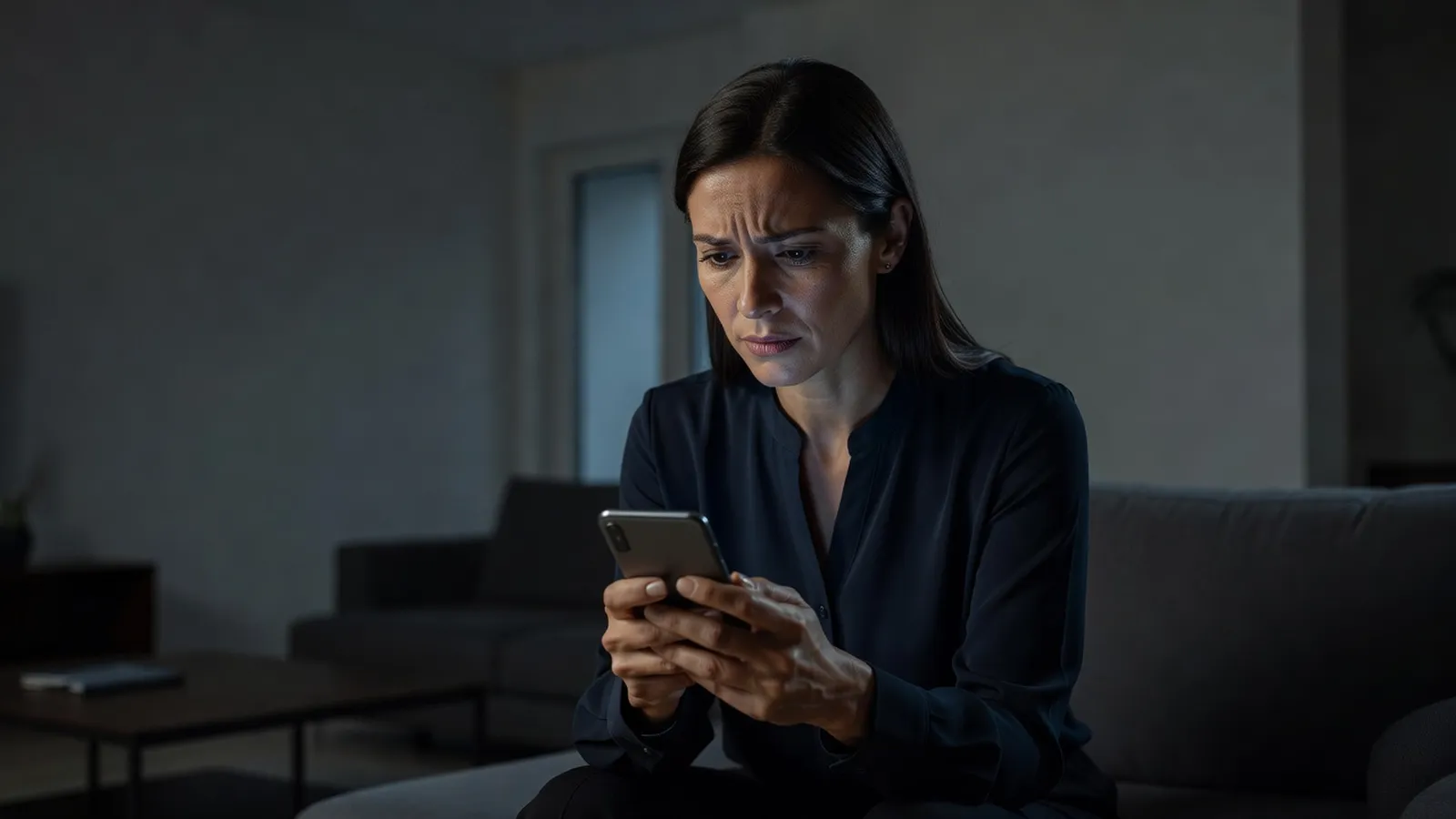
A romance scam means winning someone's trust, often through an online relationship, in order to get money out of them. The signs to watch for are a conversation someone wants to move quickly to a private messaging app, repeated refusals to appear on video, emergencies that keep piling up and, sooner or later, a request for money. If you have already paid, stop all payments, call your bank, then report everything to the police and to the Canadian Anti-Fraud Centre.
Verified on November 26, 2026 against the official pages of the Canadian Anti-Fraud Centre and the Competition Bureau, consulted on that date.
How a romance scam works
Nobody thinks, "I am about to be scammed." You think a pleasant conversation has arrived at just the right moment, that this person seems attentive, asks the right questions and remembers the details. That is precisely what the script is built to produce. A romance scam does not begin with a request for money. It begins with attention, often a great deal of it, spread over several weeks.
The pattern usually has three stages. The first is the hook: an attractive profile, a polished introduction, a warm first message on an app, a social network or a messaging service. The second is bonding: daily exchanges, confidences, quick declarations, a "we" that takes hold before the two people have even met. The third is the ask: an unexpected expense, an emergency, a project, and a question about money that always arrives as a favour between close people, never as a transaction.
What makes the method work is that it feeds on perfectly normal emotions. Wanting to be liked, the loneliness of a Canadian winter, the pleasure of being chosen: none of that is a weakness. Fraudsters know it and use it. They sometimes work in teams, with scripts prepared in advance, and can run dozens of conversations at once. The warmth you feel is real. It is the identity of the person on the other end that is not.
The Canadian Anti-Fraud Centre, the national body that receives fraud reports, covers these situations under "relationship and romance" in its documentation. Its starting advice fits in one sentence that is worth keeping as a reflex: never send money to someone you have never met. The rest of this article is a development of that sentence.
One clarification before going further: this guide is not meant to make you suspicious of everyone who writes to you online. The great majority of online connections are not fraud at all, and the site's online dating guide starts from that premise. The goal is simply to recognize the small number of situations in which romantic feeling is used as a lever.
The most common warning signs
No single signal proves fraud. It is the accumulation, and above all the sequence, that should make you slow down. Here are the signs that come up most often in the scripts described by official bodies and in victims' accounts.
A quick move to a private messaging app. The Canadian Anti-Fraud Centre notes that the person wants to move the conversation quickly to a private mode of communication such as WhatsApp, text messages or email. On a dating app, exchanges come with rules and reporting tools; elsewhere, nobody is watching. Wanting to change channels is not suspicious in itself, but it becomes a signal when it is pressing and happens within the first few days.
Feelings declared far too fast. "I have never felt this way," "you are my soulmate," "I already know I want to grow old with you": the intensity arrives before knowledge of the other person does. A healthy bond grows at a pace both people can follow. If you are pressed to feel as much as the other person says they feel, step back.
A refusal to be seen. A video call postponed every time, a camera that "does not work," a connection that is "too poor," a job that keeps them away: the excuses vary, the result is identical. Someone who says they love you but never wants to show you their face live is hiding something.
A life lived at a distance. An offshore oil platform, a humanitarian mission, a construction site abroad, a deployed soldier, a business traveller: these stories explain both why a meeting is impossible and why money is suddenly needed. They are not false by nature, but they come up so often in scam scripts that they deserve caution.
A story that contradicts itself. Details that change from one conversation to the next, a city, a job, an age, hours that do not fit the time zone claimed. Note it without accusing: it is often your best piece of information.
An emergency and a secret. A medical bill, customs fees, a plane ticket, a blocked parcel, a fine: the emergency stops you from thinking, and the secrecy cuts you off from the opinion of people close to you. "Don't tell your family, they would not understand" is one of the most revealing sentences there is.
An unusual payment request. In the most common scripts, the money must go through gift cards, a transfer to a third-party account or cryptocurrency, all channels that are hard to trace. Keep the principle rather than the list: the stranger the requested payment method, the stranger the situation.
The table below sums up the logic of these signals and the habit to adopt.
| Warning sign | What the script says | What to do |
|---|---|---|
| Quick move to a private messaging app | "We will have more privacy here" | Keep part of the exchanges on the original platform and take your time |
| Declarations of love within days | "I have never felt like this" | Slow the pace and see whether the other person respects it |
| Refusal of a live video call | "My camera is broken" | Suggest a video call at a set time; repeated absence is a strong signal |
| Financial emergency | "I need help, just this once" | Send nothing and talk to someone you trust |
| Request for secrecy | "Don't tell anyone" | Do the opposite: talk about it |
| An "investment" proposal | "I can help you make money" | Stop discussing it and check with an independent third party |
Source: Canadian Anti-Fraud Centre, "Relationship and romance"; Competition Bureau Canada, "Romance scams".
When online love leads to an "investment"
A variant that authorities increasingly describe mixes a romantic relationship with investing. The Canadian Anti-Fraud Centre has published a warning about frauds that combine cryptocurrency and romance, which it also calls "pig butchering": the victim is "fattened up" with weeks of trust before being pushed to invest.
The pattern goes like this. After affectionate exchanges, the person mentions, almost in passing, a financial success, an app or a platform that "really works." They ask for nothing at first. They show. They share screenshots of gains, talk about their own success, offer to teach you. When you decide to try, you are guided to a site that looks like a real platform, where your first deposits appear to grow. A small withdrawal may even go through, which reassures you. Then come the larger deposits, and one day it is impossible to withdraw anything: there are fees to pay, taxes, a release charge. Every extra payment only lengthens the list.
Three clues should alert you in this variant. First, the investment comes from someone you met online and whose existence you have never verified. Second, the platform is not a company you would have found on your own through an independent route. Third, the promised return is attractive, and the advice comes with emotional pressure: "if you love me, you trust me."
The habit that protects you is the same as for any request for money: no payment to someone you have never met. If investing genuinely interests you, discuss it with an independent professional you chose yourself, never with the person who proposed it in a romantic conversation. And if the relationship ends when you decline to invest, you have your answer.

What the published statistics say
Numbers help show the scale of the problem, provided they are read with care. Each year the Canadian Anti-Fraud Centre publishes a list of the most common frauds, based on the reports it receives. A report is not an exhaustive measure: many people report nothing, often out of embarrassment, which suggests the real figures are higher.
For 2024, the Anti-Fraud Centre states that romance fraud produced 1,172 reports, 1,030 victims and $58.4 million in reported losses. For 2025, the category is called "Relationship" in its top-10 list, and reported losses reach $63.3 million. Two notes on reading these figures: the label of the category changed from one year to the next, so comparisons call for caution, and these are reported amounts, not recovered ones.
What to take from them: in a single year, reported losses for this type of fraud remain in the tens of millions of Canadian dollars. Behind those totals are mostly people, of every age and background, who believed in a love story. None of these statistics says that "people of a given profile are more gullible": the sources consulted do not publish such a conclusion, and it would be wrong anyway.
Finally, note that these figures rest on reports: every additional report improves the overall picture available to the authorities.
Checking an identity without becoming paranoid
You can be open and careful at the same time. Here are simple checks, with no special technique, that you can do at any point in an online relationship.
Start with live video. Suggest a call at a specific time, preferably fairly early in the relationship. A real person agrees, sometimes with a little shyness. Someone who dodges several times in a row gives you a clear piece of information.
Next, run a reverse image search on their photos, using the service of your choice. If the same pictures appear under another name, in another country or on a stock image site, the profile is suspect. The check takes two minutes and hurts nobody.
Check the consistency of the story. Jot down the main things you are told: city, job, family, age. Invented stories are prone to slips that real life does not produce.
Watch the relationship to money. As soon as a romantic conversation drifts toward the other person's money problems, toward fees or toward an investment, the subject is no longer romance. Telling yourself "I never mix love and money with someone I have not met" is a simple rule that spares you from deciding under pressure.
Finally, talk about it. A friend, a brother, a coworker: showing the messages to an outsider is often the most effective way to see what you can no longer see from inside. Fraudsters know this, which is why they ask for secrecy. If you fear being judged, simply say: "I would like your opinion on a situation."
Beyond that, a few basic habits protect well: do not share your address, social insurance number, photos of identity documents or banking details with someone you met online; do not click links sent by a stranger; and never lend your bank account to "receive" or "transfer" money. Our article on writing a dating profile and first messages also covers the information that is better not to publish from the start.
You have sent money: the first few hours
If you are reading this after already paying, the priority is not to blame yourself: it is to act quickly. Here is the order that makes the most sense, drawn from the Canadian Anti-Fraud Centre's guidance.
1. Stop all payments. Do not send anything more, even if you are told it is "the last time," that the release is imminent or that a large sum is waiting for you. The requests keep growing as long as the victim pays. A refusal is sometimes followed by threats, emotional blackmail or, on the contrary, sudden silence: in both cases, do not give in.
2. Contact your financial institution. Call your bank or credit union, explain that you are the victim of a fraud and ask which measures are possible: blocking a card, monitoring the account, disputing a transaction. The official sources consulted for this article publish no refund deadline, no guaranteed amount and no particular fees, so do not expect anything specific, but do not wait to call, because speed matters in limiting the damage. If you shared logins or personal information, also ask how to protect them.
3. Keep the evidence. Delete nothing: messages, emails, screenshots, profile names, numbers, payment receipts, cryptocurrency wallet addresses. These items will be needed for the report. Even if the conversation is painful to reread, it is valuable.
4. Cut contact, without confrontation. Block the person or, if you prefer to report first, simply stop answering. There is no point confronting them: they will give you no useful information and might try to trap you again.
5. Report. That is the subject of the next section.
6. Watch your accounts. With your bank's help, stay alert to unusual activity over the following weeks. If you sent identity documents, ask your financial institution how to respond.
If you are in immediate danger, for example if you are being threatened, call 911: it is the one situation where the police come before everything else.
Reporting: where and how
Reporting a scam, even when the money is gone and you tell yourself it will not help, is still worthwhile. The Canadian Anti-Fraud Centre recommends reporting the incident to local police and to the Centre itself. The two steps complement each other: police handle offences in their territory, and the Anti-Fraud Centre gathers intelligence nationwide.
To the Canadian Anti-Fraud Centre. Reporting is done online, on the Centre's website, as a victim or a witness, and anonymous reporting is available. By phone, the toll-free number is 1-888-495-8501. Gather the useful details: dates, profile names, email addresses and phone numbers used, amounts, payment methods and screenshots.
To local police. For a romance fraud with no immediate danger, report it to your municipal police service and mention that the Anti-Fraud Centre will also be informed.
To the original platform. If you met on an app or social network, report the profile to the platform: this may allow it to remove the account and protect others. The Competition Bureau Canada also publishes information on romance scams, useful for understanding your rights as a consumer when a paid service is involved.

On the day you have reported, you will have done the most useful part of the work. International fraud investigations are long and their outcome uncertain; nobody can promise that the money will be recovered. But a well-documented report contributes to an overall picture the authorities would not have without you.
Getting past the shame
People talk a lot about lost money and little about what weighs heaviest for many victims: shame. "How could I not see it?" is the question that keeps coming back. The honest answer is that you were deceived by someone whose job it is, who studied what moves people and who had the time to work on you.
A few ideas for getting through this period, without any therapeutic claim. Talk to someone you trust: isolation is exactly what the script was trying to produce, and speaking up undoes that mechanism. Remember that what you felt was real for you, even if the other person was playing a part: your feelings are not ridiculous. Avoid replying to people who claim they can "recover your funds" for a fee: victims are often targeted a second time. And if the shock runs deep, it is legitimate to seek professional support from a doctor or a support service in your region.
It is also normal for the wish to meet someone to return, and nothing prevents you from getting back to it at your own pace. For those who want to try again, our guide to the first date offers ideas for simple meetings in public places that quickly turn an online exchange into a real meeting, which is exactly the opposite of a scam.
Helping someone close who is being scammed
Do you see that a parent, a friend or a coworker is in an online relationship that smells like fraud? It is delicate, because the person is often convinced and moved. A few pointers help.
Avoid frontal attacks. "You are being taken for a ride" almost always provokes a defence, because the person hears criticism of their partner as criticism of themselves. Ask questions instead: "Have you seen each other on video?", "How is the plan to meet going?", "What is the person asking for, exactly?" Open questions make people think without humiliating them.
Offer to look at the messages together and to run the reverse image search. If you do it as a pair, the discovery is shared, which hurts less than evidence brandished at someone. Remind them of the Anti-Fraud Centre's advice: never send money to someone you have never met. If money has already gone out, gently steer toward the bank, then toward reporting, at 1-888-495-8501 or online.
Above all, stay present. A person whose loved ones get angry turns more readily to whoever supports them, even if that someone is a fraudster. Your patience is a protection.
Protecting your online love life
To finish, here are a few habits to adopt, without paranoia, that make scams harder.
- Keep a slow pace. Real relationships can handle slightly more spaced-out exchanges; scam scripts cannot.
- See the person early. A video call, then a meeting in a public place when possible, rules out most frauds.
- Keep a money rule. Decide in advance that you will send nothing to someone you have not met, and stick to it without negotiating.
- Keep loved ones in the loop. A trusted person who knows you are meeting someone online is a safety net.
- Keep the conversation on the platform at first. Reporting tools exist there; elsewhere, you are on your own.
If you like to dig deeper, our interview with a cybersecurity advisor, published here as safer online dating, extends this advice from a digital-security angle. And if you wonder why people fall so quickly for someone's charm, our page on love at first sight explains what research says about rapid attraction, which helps in understanding why fraudsters play on that ground.
Frequently asked questions
How can I tell whether someone I met online is real?
No test is foolproof, but several habits lower the risk: ask for a live video call early in the relationship, check that the photos are not circulating elsewhere under another name, compare the person's story from one conversation to the next, and be wary of anyone who keeps refusing to show their face. The Canadian Anti-Fraud Centre stresses one simple principle: never send money to someone you have never met.
What are the most common warning signs?
The Canadian Anti-Fraud Centre notes, among other things, a wish to move the conversation quickly to a private channel such as WhatsApp, text messages or email. In the most common scripts, this is followed by very fast declarations of love, excuses for never meeting or appearing on video, a financial emergency and, sooner or later, a request for money or an "investment" proposal.
I have sent money: what should I do first?
Stop any further payment, even if you are promised a refund. Contact your financial institution right away to explain what happened, then report the incident to your local police and to the Canadian Anti-Fraud Centre, online or at 1-888-495-8501. If you are in immediate danger, call 911.
Where do I report a romance scam in Canada?
To the Canadian Anti-Fraud Centre, online or by toll-free phone at 1-888-495-8501, and to your local police. The online report can be filed as a victim or a witness, and the site also offers anonymous reporting.
Will my losses be refunded?
Nothing guarantees it, and the official sources consulted do not publish a refund deadline or a mandatory refund amount. The sooner you contact your bank, the better your chances of limiting the damage, but the outcome depends on your institution and the payment method used.
Where to find official information
The reference pages are those of the Canadian Anti-Fraud Centre: its page on relationship and romance scams describes how they work and what to watch for, and its page What to do if you are a victim of fraud details the steps. The Competition Bureau Canada publishes its own page on romance scams. Official pages are updated regularly: reread them before acting, since phone numbers, forms and instructions can change.
General information only. It does not replace advice from a lawyer or an immigration consultant.
Frequently asked questions
How can I tell whether someone I met online is real?
No test is foolproof, but several habits lower the risk: ask for a live video call early in the relationship, check that the photos are not circulating elsewhere under another name, compare the person's story from one conversation to the next, and be wary of anyone who keeps refusing to show their face. The Canadian Anti-Fraud Centre stresses one simple principle: never send money to someone you have never met.
What are the most common warning signs?
The Canadian Anti-Fraud Centre notes, among other things, a wish to move the conversation quickly to a private channel such as WhatsApp, text messages or email. In the most common scripts, this is followed by very fast declarations of love, excuses for never meeting or appearing on video, a financial emergency and, sooner or later, a request for money or an "investment" proposal.
I have sent money: what should I do first?
Stop any further payment, even if you are promised a refund. Contact your financial institution right away to explain what happened, then report the incident to your local police and to the Canadian Anti-Fraud Centre, online or at 1-888-495-8501. If you are in immediate danger, call 911.
Where do I report a romance scam in Canada?
To the Canadian Anti-Fraud Centre, online or by toll-free phone at 1-888-495-8501, and to your local police. The online report can be filed as a victim or a witness, and the site also offers anonymous reporting.
Will my losses be refunded?
Nothing guarantees it, and the official sources consulted do not publish a refund deadline or a mandatory refund amount. The sooner you contact your bank, the better your chances of limiting the damage, but the outcome depends on your institution and the payment method used.
Sources
Verified on
- Centre antifraude du Canada, Relationship and romance, antifraudcentre-centreantifraude.ca, 2020.
- Centre antifraude du Canada, Top 10 frauds in 2025, antifraudcentre-centreantifraude.ca, 2026.
- Centre antifraude du Canada, Fraud Prevention Month 2025, antifraudcentre-centreantifraude.ca, 2025.
- Centre antifraude du Canada, What to do if you're a victim of fraud, antifraudcentre-centreantifraude.ca, 2020.
- Centre antifraude du Canada, Report fraud and cybercrime, antifraudcentre-centreantifraude.ca, 2020.
- Centre antifraude du Canada, Warning on crypto and romance frauds, antifraudcentre-centreantifraude.ca, 2024.
- Gouvernement du Canada, Romance scams, competition-bureau.canada.ca, 2022.